Resources & Insights
How to Open a Boutique Fitness Studio in Dallas: Startup Costs, Location, Equipment & More
Thinking about opening a boutique fitness studio in Dallas? From Pilates and yoga studios to strength training, cycling, HIIT, barre, and recovery concepts, boutique fitness has become an increasingly competitive business category.
But opening a fitness studio involves much more than finding a location and purchasing gym equipment.
Before signing a commercial lease, you need to understand boutique fitness studio startup costs, fitness studio business plans, equipment costs, membership pricing, location selection, marketing, staffing, and monthly operating expenses.
This guide walks through the major steps involved in starting a boutique fitness studio in Dallas, Texas.
What Is a Boutique Fitness Studio?
A boutique fitness studio is a specialized fitness business that focuses on a particular workout, training method, or customer experience.
Common boutique fitness business ideas include:
- Pilates studios
- Reformer Pilates studios
- Yoga studios
- Barre studios
- HIIT studios
- Indoor cycling studios
- Strength training studios
- Personal training studios
- Boxing fitness studios
- Lagree studios
- Dance fitness studios
- Recovery and wellness studios
Unlike a traditional large gym, a boutique fitness studio generally focuses on a specific type of workout and a more personalized customer experience.
That specialization is one of the reasons boutique fitness continues to attract entrepreneurs.
How to Start a Boutique Fitness Studio
If you're researching how to open a fitness studio, start with the business rather than the physical location.
A good starting process looks like this:
- Choose your fitness concept
- Research your target market
- Analyze competitors
- Create a fitness studio business plan
- Calculate startup costs
- Determine your pricing model
- Find a location
- Plan your equipment needs
- Handle business and legal requirements
- Develop your branding and website
- Begin pre-opening marketing
- Build your founding membership
- Hire and train staff
- Open your studio
Each step affects the next.
For example, a reformer Pilates studio has very different equipment requirements from a yoga studio. A cycling studio has different space and technology requirements from a personal training studio.
So there isn't one standard formula for opening a boutique fitness business.
1. Choose the Right Boutique Fitness Business Concept
The first question isn't: "Where should I open my studio?"
It's: "What type of fitness studio should I open?"
Your concept determines your target customer, equipment, class capacity, pricing, staffing, location requirements, and startup budget.
Popular Fitness Studio Business Ideas
| Fitness Studio Concept | Typical Customer |
|---|---|
| Reformer Pilates | Customers interested in low-impact strength and movement |
| Yoga Studio | Customers interested in flexibility and mind-body wellness |
| Barre Studio | Customers interested in strength, balance and conditioning |
| HIIT Studio | Customers looking for high-intensity group workouts |
| Cycling Studio | Cardio-focused fitness customers |
| Strength Studio | Customers interested in strength and performance |
| Personal Training Studio | Customers looking for individualized coaching |
| Boxing Fitness Studio | Customers interested in conditioning and boxing-inspired workouts |
| Lagree Studio | Customers seeking high-intensity, low-impact workouts |
| Recovery Studio | Fitness and wellness customers |
Don't choose a concept simply because it is trending. Research whether there is enough demand for that concept in the specific Dallas neighborhood you are considering.
2. Research the Dallas Fitness Market
If you're searching for how to open a fitness studio in Dallas, market research should be one of your first steps.
Dallas isn't one single market.
The ideal customer for a luxury Pilates studio in Highland Park may be very different from the customer for a strength-training studio in another part of DFW.
Research:
- Population
- Household income
- Age demographics
- Existing gyms
- Pilates studios
- Yoga studios
- Boutique fitness studios
- Fitness franchises
- Nearby residential communities
- Traffic
- Parking
- Competition
- Local businesses
- Potential membership demand
Questions to Ask Before Choosing a Dallas Location
- How many competitors are nearby?
- What are they charging?
- Are their classes full?
- What do their Google reviews say?
- Who is their target customer?
- What services are missing from the market?
- Would your concept give customers a reason to choose you instead?
This is much more valuable than simply searching for the cheapest available commercial space.
3. Create a Fitness Studio Business Plan
A boutique fitness studio business plan should explain how the business will attract customers, generate revenue, and cover its expenses.
Your business plan should include:
- Business concept: What type of fitness studio are you opening?
- Target market: Who is your ideal member?
- Competitor analysis: Who are you competing against?
- Pricing strategy: How much will memberships and classes cost?
- Revenue model: How will the studio make money?
- Startup costs: How much capital is required to open?
- Monthly expenses: What will it cost to operate the studio?
- Marketing strategy: How will you get your first customers?
- Financial projections: When do you expect to reach your break-even point?
A business plan is also useful when seeking fitness studio financing, SBA financing, investors, or business loans.
4. How Much Does It Cost to Open a Boutique Fitness Studio?
This is one of the biggest questions prospective studio owners ask: "How much does it cost to open a boutique fitness studio?"
The answer depends heavily on the concept, location, studio size, equipment, condition of the existing space, and level of customization.
Current industry guides show startup estimates ranging from roughly $50,000–$150,000+ for smaller or simpler concepts, while larger or more equipment-intensive studios can require several hundred thousand dollars in total funding.
That is why it's better to build your own startup-cost model.
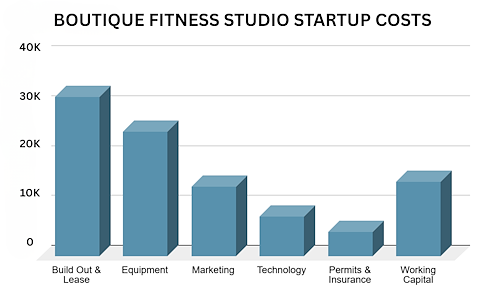
Boutique Fitness Studio Startup Costs
| Expense | What It Can Include |
|---|---|
| Commercial lease | Deposit and initial rent |
| Studio build-out | Preparing the space for your business |
| Fitness equipment | Reformers, bikes, weights, mats, machines, etc. |
| Mirrors | Studio mirrors |
| Sound & AV | Speakers, microphones and screens |
| Technology | Scheduling, POS and membership software |
| Insurance | Business and liability coverage |
| Permits | Applicable permits and approvals |
| Branding | Logo, signage and brand development |
| Website | Website and online booking |
| Marketing | Pre-opening and launch campaigns |
| Payroll | Pre-opening staffing and training |
| Working capital | Cash reserve for early operating months |
One 2026 planning model puts a typical boutique studio's broader funded startup range around $150,000–$600,000, illustrating how dramatically the number can change depending on the concept and scale.
5. How Much Does It Cost to Open a Pilates Studio?
If you're specifically researching how to open a Pilates studio, your equipment budget can be significantly different from a yoga or mat-based fitness studio.
A reformer Pilates studio may require:
- Pilates reformers
- Towers
- Mats
- Props
- Storage
- Mirrors
- Sound equipment
- Scheduling software
- Specialized instructor training
One 2026 startup analysis notes that a Pilates studio with approximately 12 reformers could spend roughly $30,000–$50,000 on equipment alone, depending on the equipment selected.
That makes Pilates studio startup costs an important part of your financial planning.
6. How Much Space Do You Need for a Fitness Studio?
Another common search for new studio owners is: "How much space do I need for a fitness studio?"
There isn't one universal answer.
Your required fitness studio square footage depends on:
- Class size
- Equipment
- Number of instructors
- Reception requirements
- Storage
- Bathrooms
- Locker areas
- Private training rooms
- Circulation
- Type of workout
A 10-person Pilates studio and a 30-person HIIT studio don't have the same space requirements.
Before signing a lease, understand exactly how much usable space your business needs.
7. Choosing a Location for Your Fitness Studio
Fitness studio location is one of the most important business decisions you'll make.
A good location should work for both your customers and your business model.
Consider:
- Visibility: Can people easily find the studio?
- Accessibility: Can members easily get there?
- Parking: Is there enough parking during your busiest class times?
- Demographics: Does the surrounding area contain your target customer?
- Competition: How many similar businesses are nearby?
- Rent: Can the location support your projected membership revenue?
- Growth: Are new apartments, homes, offices, restaurants, or retail businesses coming into the area?
For a Dallas fitness studio, location research should be extremely specific.
Don't simply search "best areas in Dallas." Determine where your specific customer lives and works.
8. Understand Your Fitness Studio Lease
Before signing a commercial lease for a fitness studio, understand the financial and operational terms.
Look at:
- Monthly rent
- Lease term
- Security deposit
- Rent increases
- Tenant improvement allowance
- Permitted use
- Operating expenses
- Maintenance responsibilities
- Signage rights
- Parking
- Renewal options
- Construction requirements
- Delivery condition of the space
A low monthly rent isn't necessarily a good deal if the space requires significant work before you can operate.
Likewise, a higher-rent location may make sense if it provides stronger visibility, demographics, accessibility, and customer demand.
9. Create a Fitness Studio Equipment List
Your fitness studio equipment list should be based on your actual class format.
Pilates Studio
- Reformers
- Towers
- Pilates chairs
- Mats
- Resistance bands
- Small props
- Storage
Yoga Studio
- Yoga mats
- Blocks
- Straps
- Bolsters
- Blankets
- Storage
Strength Studio
- Dumbbells
- Barbells
- Racks
- Benches
- Kettlebells
- Resistance equipment
Cycling Studio
- Indoor bikes
- Sound system
- Instructor microphone
- Displays
- Lighting equipment
Don't purchase equipment simply because another studio has it. Calculate your equipment cost per class, expected class size, and membership capacity.
10. How to Price Fitness Studio Memberships
Fitness studio membership pricing can determine whether your business succeeds.
Potential pricing models include:
- Monthly memberships
- Unlimited memberships
- Class packages
- Drop-in classes
- Introductory offers
- Private training
- Small-group sessions
- Premium memberships
| Membership Type | Purpose |
|---|---|
| Intro Offer | Convert first-time visitors |
| 4 Classes/Month | Entry-level membership |
| 8 Classes/Month | Regular customer |
| Unlimited | High-frequency customer |
| Class Pack | Flexible customer |
| Private Training | Premium revenue |
| Drop-In | Occasional customer |
Don't automatically underprice your memberships to compete.
Your pricing needs to cover:
Rent + payroll + software + marketing + insurance + utilities + other expenses + profit
11. How Many Members Does a Fitness Studio Need?
This is where your financial model becomes important.
Suppose your monthly operating expenses are:
$30,000
And your average monthly revenue per member is:
$150
A simplified break-even calculation would be:
$30,000 ÷ $150 = 200 members
That's only an example.
Your actual fitness studio break-even point should account for:
- Different membership levels
- Class capacity
- Instructor costs
- Member cancellations
- Payment processing
- Retail revenue
- Private training
- Seasonal fluctuations
Before opening, determine:
How many members do I need to break even?
That number should influence your location, pricing, class schedule, and marketing strategy.
12. How to Get Your First Fitness Studio Members
A new fitness studio shouldn't wait until opening day to find customers.
Start marketing before the studio opens.
Pre-Sale Strategy
Create a founding membership. Offer early customers a special rate or membership package.
Build a Waitlist
Create a landing page targeting searches such as:
- "New Pilates studio coming to Dallas"
- "New boutique fitness studio in [Dallas neighborhood]"
Social Media
Start building your audience before opening.
Post:
- Studio updates
- Trainer introductions
- Workout content
- Brand story
- Opening announcements
- Founding-member offers
Local SEO
Create your Google Business Profile and optimize your website for searches such as:
- Pilates studio near me
- boutique fitness studio Dallas
- fitness studio Dallas TX
- yoga studio Dallas
- reformer Pilates Dallas
- personal training Dallas
Local SEO can become one of your most valuable long-term acquisition channels.
13. Fitness Studio Marketing Ideas
Your fitness studio marketing strategy should include both online and local marketing.
Consider:
- Google Business Profile
- Local SEO
- Google Ads
- TikTok
- Email marketing
- Referral programs
- Influencer partnerships
- Grand-opening events
- Founding-member campaigns
- Local business partnerships
- Community events
Don't depend entirely on Instagram.
Someone searching: "Pilates studio near me" has a much stronger purchase intent than someone casually scrolling through a fitness Reel.
14. Fitness Studio Software
Modern fitness studios typically need technology for:
- Class scheduling
- Online booking
- Membership management
- Payments
- Customer communication
- Attendance
- Automated reminders
- Reporting
Your fitness studio management software should make it easier to manage members rather than create additional work.
Before selecting a system, compare:
- Monthly cost
- Payment processing
- Scheduling
- Mobile app
- Automated communication
- Reporting
- Integrations
- Customer support
15. Fitness Studio Staffing
Depending on your business model, you may need:
- Fitness instructors
- Personal trainers
- Front desk staff
- Studio manager
- Sales staff
- Marketing support
- Cleaning services
For a boutique fitness studio, instructors are particularly important because the instructor can become part of the customer's reason for returning.
Your staffing model should account for:
Payroll + class capacity + membership revenue.
16. What Permits Do You Need to Open a Fitness Studio in Texas?
Before opening, research the applicable Texas business requirements, local permits, certificates, insurance requirements, and occupancy requirements for your specific location and business activity.
Requirements can vary based on the city, property, services offered, and scope of work.
For a Dallas-area business, don't assume that the requirements for one fitness studio automatically apply to another.
17. Best Dallas Areas to Consider for a Boutique Fitness Studio
Choosing the right fitness studio location in DFW can be just as important as choosing the right fitness concept. A premium Pilates studio, luxury gym, recovery center, or wellness studio needs to be positioned where its target customers already live, work, shop, dine, and spend their leisure time.
For entrepreneurs planning a boutique fitness studio in Dallas, several neighborhoods and surrounding DFW cities are worth researching.
| Dallas / DFW Area | Potential Fitness & Wellness Opportunity |
|---|---|
| Dallas Design District | Premium wellness, Pilates, boutique fitness & lifestyle concepts |
| Uptown Dallas | Young professionals, luxury apartments, fitness & wellness |
| Knox-Henderson | Upscale residential, dining, retail & lifestyle businesses |
| Highland Park | Luxury fitness, Pilates, wellness & premium services |
| University Park | Affluent residential and professional customer base |
| Preston Hollow | Luxury wellness, private training & premium fitness |
| Turtle Creek | High-end residential and urban lifestyle |
| Lakewood | Fitness, wellness and community-focused concepts |
| Bluffview / Devonshire | Premium neighborhood-focused businesses |
| Plano | Established affluent suburban market |
| Frisco | Rapidly growing premium fitness and wellness market |
| Southlake | Luxury retail, fitness and wellness |
| Prosper | Growing affluent residential market |
| West Plano | Corporate, residential and premium service market |
| Addison | Dense residential, business and lifestyle market |
Boutique Fitness Studio Startup Checklist
- Fitness concept
- Target customer
- Competitor research
- Dallas market research
- Business plan
- Startup budget
- Working capital
- Financing
- Location
- Commercial lease
- Studio square footage
- Equipment
- Insurance
- Permits
- Business registration
- Fitness studio software
- Website
- Branding
- Membership pricing
- Marketing strategy
- Staff
- Founding membership campaign
- Grand opening
Opening a Boutique Fitness Studio in Dallas: The Bottom Line
If you're serious about starting a boutique fitness studio, don't start with the question:
"How do I make the studio look good?"
Start with:
"Can this business work financially?"
Research your Dallas market. Define your target customer. Calculate boutique fitness studio startup costs. Determine your membership pricing. Understand your break-even point. Choose your location carefully. Then plan the physical space around the business.
The physical location is an important part of the customer experience, but it should support the business model rather than determine it.
If you're planning to open a fitness studio in Dallas, TX, Squarefoot Construction can help you take the next step from business concept to physical location.